

For over twenty-five years, the people of Healing Transitions have known her as “Nurse Kat,” (even though she will tell you she’s not a real nurse)! She moves quietly through the halls of the Men’s and Women’s Campuses, coordinating doctor visits, organizing medications, calming anxious patients, and making sure no one slips through the cracks. But long before she became the steady presence so many rely on today, Kat Thomas was simply someone searching for where she was supposed to be.
In 2001, before the first detox beds opened here at Healing Transitions, Kat sat on the edge of her bed watching a small television report about a recovery program in Louisville called The Healing Place. The segment ended with an announcement: the model was coming
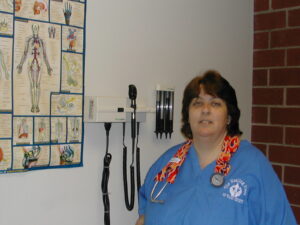
2001: Kat in the Healing Place of Wake County medical clinic.
to Raleigh.
“Oh my God,” she remembered thinking. “I want to work there.”
At the time, Kat was already working in the healthcare sector. She had spent years in doctors’ offices, balancing medical responsibilities with recovery of her own. But something about this new place felt different. When a job opportunity finally came, she applied immediately, though not without a little drama. Her faxed résumé mysteriously disappeared twice before finally reaching the hiring manager. She later discovered a patient working in accounting had shredded them, mistakenly believing Kat was betraying her current employer by applying elsewhere.
Still, the résumé eventually made it through and Nurse Kat joined Healing Transitions on April 12, 2001, during the earliest training days before the Men’s Non-Medical Detox Center officially opened. Back then, the organization was little more than a vision and a handful of determined staff members trying to build something that had never existed in Wake County before.
“We had about thirty staff members,” Kat said. “Now there are so many people, I don’t even know who everybody is anymore.”
In those early years, everyone did everything. Kat worked night shifts in both detox and the emergency shelter, racing back and forth between crises. She became detox coordinator before eventually helping run the organization’s first medical clinic, which at the time operated only one night a week from 5:30 p.m. to 9:00 p.m.
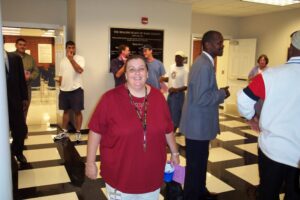
2002: Kat in the Men’s Campus lobby.
“When I first started,” she said, “I knew everybody’s name. I knew what medications everybody took.”
Now, after helping thousands of participants who have walked through the doors over the last twenty-five years, she often catches herself smiling apologetically and saying, “Remind me of your name again?”
This growth is staggering to someone who remembers every inch of the organization’s earliest days. In the beginning, she was on call every six weeks because there were so few people to share responsibilities. Today, she rotates on call only every fifteen weeks, a small but powerful reflection of how much Healing Transitions has expanded over the last quarter century.
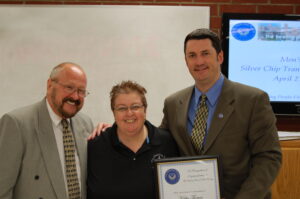
2011: Kat celebrating 10 years of employment with the Healing Place of Wake County.
Health services at Healing Transitions now extend across both campuses, connecting participants to our volunteer medical clinics, mental health support, outside providers, affordable medications, and consistent care regardless of whether they have insurance.
For Kat, affordability has always mattered deeply.
“We pay everybody’s co-pays,” she explained. “We pay for prescriptions, even if they don’t have insurance.”
Because Nurse Kat knows firsthand what happens when healthcare becomes inaccessible. For many experiencing homelessness, the emergency room becomes primary care by default, a pricey and inefficient last-resort option. Part of her mission has been teaching participants how to navigate healthcare differently by encouraging the use of urgent care, providing connections to primary care doctors, and assisting with Medicaid applications.
Much of that work would be impossible without the network of volunteer physicians who donate their time and expertise to the clinic. Retired gynecologists, emergency room physicians, and primary care doctors continue showing up week after week.
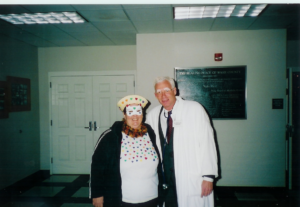
2005: Kat and Dr. Bob (a volunteer doctor) during Halloween.
“The oldest doctor is eighty-four,” Kat laughed. “And he still comes twice a month.”

Another physician, who has been volunteering since 2001, continues seeing patients despite a tremor that prevents him from writing notes by hand. Instead, he dictates while Kat types beside him.
“He still comes,” she said simply. “And it still makes a difference.”
Over the years, Kat has continuously expanded her own skills to better serve the community. While working full-time, she completed EMT training, phlebotomy school, and pharmacy technician courses. But despite all the training, she never chased higher-paying jobs elsewhere.
“My kids used to tell me all the time, ‘You could make so much more money somewhere else,’” she said. “But it’s not about the money. This is where I’m supposed to be.”
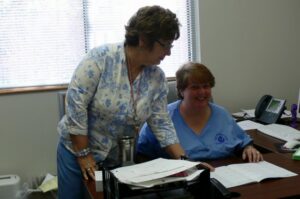
2006: Kat working in the newly opened Women’s Campus’ clinic.
Her connection to the work comes from more than professional experience. Kat was still relatively new in her recovery journey when she joined Healing Transitions in 2001. This November, she will celebrate twenty-nine years in recovery, a milestone she credits in large part to her faith and the compassion it has instilled in her throughout the years.
“I get them,” she said. “They can’t BS me because I’ve been there.”
That honesty creates trust. Residents who discover Nurse Kat is also in recovery often relax immediately, realizing the person helping them understands addiction from the inside out.
Still, twenty-five years in recovery work comes with heartbreak. For every success story, there are losses too. People she believed were thriving who later had a return to use or passed away unexpectedly.
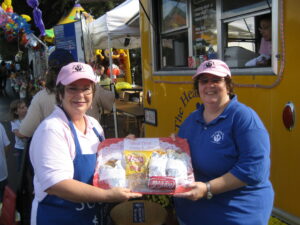
2007: Jo (one of the first staff members at the Women’s Campus) and Kat.
“There are a lot of miracles,” she said softly, “but there are also a lot of heartaches.”
Yet even after all these years and all the grief, she remains exactly where she started: showing up for people who need help.
When the Women’s Campus first opened in 2006, Kat and another staff member spent the night there alongside the first residents. The showers flooded. Water spilled into the hallways. One woman had to walk across the building wrapped in a towel just to bathe elsewhere.
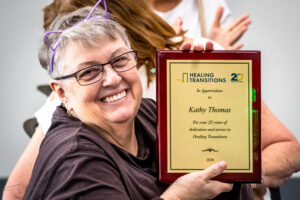
2026: Kat celebrates 25 years of employment with Healing Transitions, formerly known as the Healing Place of Wake County.
But no one complained. “Everybody called it the Healing Palace,” Kat remembered with a smile.
As Healing Transitions grew from its humble beginning into the organization it is today, Kat’s life was changing too. Over the last twenty-five years, she watched her own children grow up, get married, and start families of their own.
“In twenty-five years, I went from having kids in school,” she said, “to becoming a grandmother.”
Today, she is grandmother to five boys and one girl, a reminder that while she helped thousands of participants rebuild their lives, she was quietly building her own alongside them.